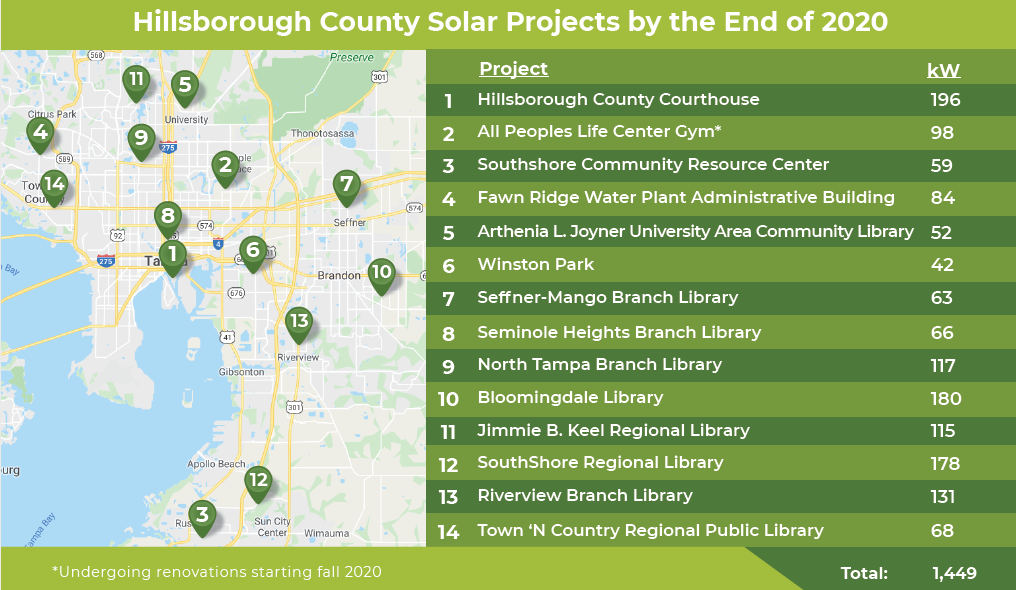
“For more than a decade, Hillsborough County has been leading an aggressive effort to implement solar energy technologies. Currently, there are 1,449 kilowatts or 1.4 megawatts on county buildings, such as libraries, throughout the community,” said Hillsborough County Commissioner Mariella Smith. “These improvements are cutting energy costs, reducing emissions, and creating more resilient energy sources that can keep critical infrastructure and services running through hurricanes and other crises.”
The initiative was motivated by a desire to cut energy costs, reduce emissions, and create more resilient energy sources that could keep critical infrastructure and services running through hurricanes and other crises. A sustainability grant served as a catalyst for new solar projects, the first of which was the installation of a 195kW rooftop system at the Hillsborough County Courthouse in 2010. That same year, the county installed a 98kW system at All Peoples Life Center Gym. Together, these projects have offset over 6 million pounds of greenhouse gases since their inception.
The installation of a 59.0 kW canopy installation at the Southshore Community Resource Center and an 83.7 kW ground mount solar system at the Fawn Ridge Water Plant Administration building also helped create solar energy technologies at two other existing facilities. While multiple considerations must be taken into account when installing solar on existing buildings, efficiency can be optimized when solar is incorporated into the design of new construction. This was the case with the installation of a 52.4 kW rooftop system at the Arthenia L. Joyner University Area Community Library. Since then, county officials have identified eight additional libraries to have solar technology installed by the end of 2020. To highlight just how much clean energy is being generated, the county has installed 55-inch televisions in the libraries equipped to enable the public to watch real-time energy production. Read the full article here.
Learn more about the Clear Sky Tampa Bay partnership.